
Volunteer


Volunteer Membership
Interested in volunteering for our department? Let us know using the link below, you will be notified via email when we begin accepting applications. We recruit new members 1-2 times a year starting with our wildland team. Next academy will be in early 2027.
Prospective members must pass a background check and have a good driving record.
The program requires a significant investment of time, consistent participation in training, and a sustained commitment to meeting rigorous professional and physical standards.
VOLUNTEER INTEREST FORM
Different types of programs that Nederland Fire Protection District offers
Structural firefighting involves the specialized techniques, equipment, and strategies used to extinguish fires in homes, commercial buildings, and other man-made structures. It focuses on interior fire attacks, search and rescue, and protecting structural integrity, using heavy, heat-resistant turn-out gear and breathing apparatus.
This is the most demanding and time-intensive program the District offers but will allow the firefighter the widest range of opportunities and education.
Becoming a volunteer structural firefighter requires hard work and dedication, a successful member of the department will spend no less than 2 years completing all the requirements needed. If you are considering volunteering, please take the time to read the below information prior to applying.
Required certifications (completed within 2 years):
- EMS - either EMR (56 hours) or EMT (156 hours) course is provided in-house and State and National certification after course completion is required.
- Firefighter I - (45 classroom, 135 hands-on hours) course is provided by Boulder County, includes testing on hazmat operstions and awarness through the Colorado Division of Fire Prevention and Control (DFPC).
- S130/190 - NWCG S-130 (Firefighter Training) and S-190 (Introduction to Wildland Fire Behavior) are the foundational, mandatory training courses for entry-level wildland firefighters.
- FEMA IS-100, 200, 700, and 800 - Foundational, free online independent study courses from the Emergency Management Institute (EMI) that provide training on the National Incident Management System (NIMS) and the Incident Command System (ICS).
Minimum yearly requirements to remain active:
- Response to no less than 10% of disptached calls (approximately 40 calls/year)
- Attend no less that 16 hours of standard training per quarter (64 hours per year)
- Complete quarterly shifting requirements:
- In-District (volunteer lives within NFPD's fire district) - 6 "on call" night shifts
- Shift-based (volunteer lives outside district boundaries) - 36 hours/month (108 hours/quarter) of in-station shift coverage (10 hours must be at night).
The Wildland program is one of the newest programs to the District and is still in development. New information will be added as it becomes available.
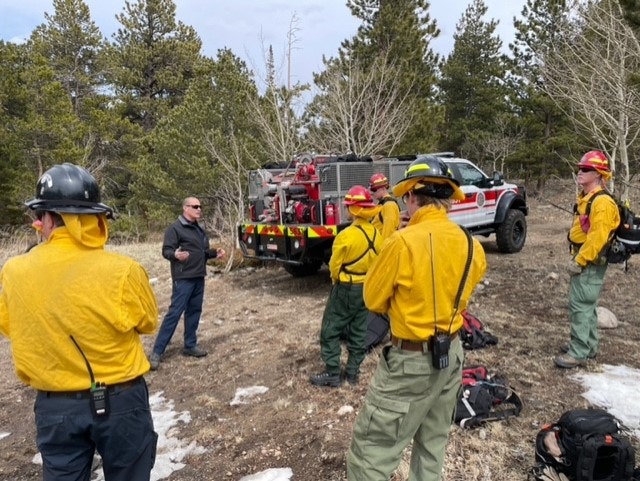
Wildland firefighting is the specialized practice of preventing, managing, and suppressing fires in forests, grasslands, and wilderness areas. These firefighters use methods like creating firelines, burning fuels, and aerial operations to protect natural resources and communities, often operating in remote, challenging, and high-stakes conditions.
Required certification/testing:
- S130/190 - NWCG S-130 (Firefighter Training) and S-190 (Introduction to Wildland Fire Behavior) are the foundational, mandatory training courses for entry-level wildland firefighters.
- FEMA IS-100, 200, 700, and 800 - Foundational, free online independent study courses from the Emergency Management Institute (EMI) that provide training on the National Incident Management System (NIMS) and the Incident Command System (ICS).
Minimum yearly requirements to remain active:
- Being available for at least 2 national assignments, each assignments lasting approximately 2 weeks from March until October.
- Wildland resfresher course (annually after initial completion of S130/190)
- Arduous Pack Test - 3-mile walk on level terrain completed in 45 minutes or less while wearing a 45-pound pack.
Wildland firefighters are compensated for their time during assignments, standard and overtime are paid by the federal government using the Colorado Division of Fire Prevention and Control (DFPC) to process all billable time. Compensation is based on the position of the resource order using DFPC's current years position pay matrix with an additional 30% added to the base rate to cover the cost of living in Boulder County.
2026 Position Pay Matrix
Fire mitigation work refers to proactive actions taken before a wildfire to reduce its intensity, speed, and potential to destroy property. It involves creating defensible space (managing vegetation and fuel)by maintaining a buffer zone between a building and the surrounding wildland vegetation. It involves reducing, clearing, or replacing combustible fuels (like trees and shrubs) to slow the spread of fire, protect the structure, and provide a safer area for firefighters to operate.
Currently, the District has partnered with Timberline Fire to provide mitigation to our community. We hope to develop and create our own mitigation team within in the next couple of years, as information becomes available this site will be updated.
Currently, the District is unable to offer EMS-only positions. Approximately 60% of the District calls are EMS-related so volunteering as a structural firefighter will give you a lot of opportunity to use your medical skills.
Guide for Family MembersRecruit/Probationary Firefighter Job Description